Les Alouettes ont dans leur alignement, C. Johnson secondeur intérieur A 6´1 235 livres il a signé le 15/10/25, une prolongation de contrat jusqu’en 2027.
D’autres secondeurs intérieurs A devraient être signés pour le camp d’entraînement.
Les Alouettes ont dans leur alignement, C. Johnson secondeur intérieur A 6´1 235 livres il a signé le 15/10/25, une prolongation de contrat jusqu’en 2027.
D’autres secondeurs intérieurs A devraient être signés pour le camp d’entraînement.
I expect us to sign Brodrique
Yeah, it’s hard to know what will happen with C. Johnson. He could be a viable backup, or he could be the next K.D. Davis – a guy bouncing on and off the active roster and mostly there for his work on special teams. So I would expect a bit more depth to be signed for that position heading into 2026 training camp.
Caleb Johnson is intriguing but I agree we will need to bring competition
Bubba Bolden showed great things too all though he’s not a Mike backer
Sur la liste de négociations des Alouettes, en date du 12/12, il y deux (2) secondeurs intérieurs:
1-Michael Barrett de Michigan 5´11 230 livres
2-Dyontae Johnson de Toledo 6´2 230 livres
Cette liste varie très fréquemment, avec des ajouts et des départs.
So many Johnsons!
We don’t know whether Sankey may even have asked to be released (unlikely, but still a possibility) … players who are released not at their request never feel kindly in the short term, but Dm releasing him once they decided to move on is a 12/10 move in terms of goodwill from agents and even other players.
DM mentionne dans l’article à peu près toutes les “ mauvaises “ bonnes raisons de signer un joueur ici Dequoy. Sympathique, dévoué à la communauté, apprécié de ses coéquipiers etc,. Presque rien à propos de ses performances de l’an passée et surtout muet en ce qui concerne Richards.. intriguant.
Je crois qu’il va signer tous les deux.
S’agissant de renouveler le contrat d’un joueur, je pense qu’on doit davantage considérer ce qu’il pourra donner dans l’avenir que ce qu’il a pu donner dans le passé. Le passé compte parce qu’il comporte plus de données qu’on peut en avoir pour un joueur recrue, mais il demeure qu’on ne bâtit pas une équipe pour les saisons passées.
Si le VP-DG ne l’a pas compris, ses adjoints le savent, eux.
I’m not opposed at all to bringing Dequoy back, but given how swift Danny was to release Sankey and turn over his position to GCA, I would hope that Dequoy’s position is undergoing the same careful audit that MLB did.
Je pense que Dequoy devra gagner son poste au prochain camp d’entraînement.
I would agree. We cut Walter Fletcher, who was coming off a great year, in last year’s training camp. Sankey gave us 2.5 excellent years before being shown the door and he wasn’t washed up. I think it’s important for Danny to show that the same standards applied to American players should apply to Canadians when appropriate. Otherwise, we risk becoming a place where talented Americans don’t want to go because they feel, rightly or wrongly, that there is a double standard based on passport.
I understand that ratio drives decisions, but it can’t be everything, and you still have to treat your American players with respect.
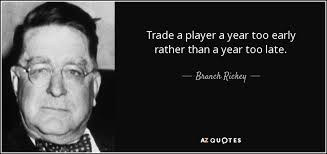
Beyond ratio, DM may have applied the Branch Rickey rule
As some have pointed out, Sankey’s stats were still good this season but perhaps not as dominant as 2023 and 2024.
Also, I would suggest that giving Sankey a two month head start on free agency was pretty respectful.
Yes, but you’ve still fired the man, taken away his job. I agree that it’s better to cut a guy a year too late early than a year too late, as a general rule, provided it’s applied fairly across the board and not only to American players. It’s an equity issue.
Of course, American players are theoretically easier to replace than nationals.
Au sujet d’un traitement équivalent entre joueurs américains et canadiens, selon moi il n’existe pas.
On aura toujours plus de considérations de toutes sortes (monétaire, ancienneté, implication dans la communauté, etc ) envers le joueur canadien, le favorisant donc dans la négo de son contrat. En gros il pourra obtenir plus d’argent à rendement égal qu’un autre joueur américain. Ceux-ci malheureusement sont jetables et remplacables facilement…désolant, mais c’est la réalité.
Je pense que Sankey n’aura pas de difficulté à trouver preneur. Les Alouettes lui donnent simplement plus de temps pour discuter avec les équipes intéressées.
La question du traitement équitable comporte d’autres facteurs à considérer.
I get what you’re saying, but I think the belief that Americans are easily replaced is overstated. Teams are obliged to start a minimum of eight Canadians out of a total of twenty-two starting positions (offence + defence). That’s just over a third of your starters, leaving just under two-thirds (or fourteen) of your starters to be filled by Americans. And you have to find quality backups. Yes, there are way more American players in theory than Canadian players based on country populations, money, and so on, but we don’t get access to all those guys, and the absolute cream of that crop go the NFL route. And some guys will not leave the US for football either. And another chunk of those guys will not be able to adapt to the Canadian game. So the pool of viable Americans is smaller than we think.
Look no further than Ed Hervey in Edmonton to see how a GM who views players as disposable cheap labour fares. He publicly humiliated Geno Lewis last year and tried to field a receiving corps on the cheap, on the theory that American receivers are easily replaced. Well, that may be true in the abstract, but quality Americans are not easily replaced at any position. If Edmonton hadn’t alienated Lewis and kept him on a smaller contract for another year, they’d likely have made the playoffs.